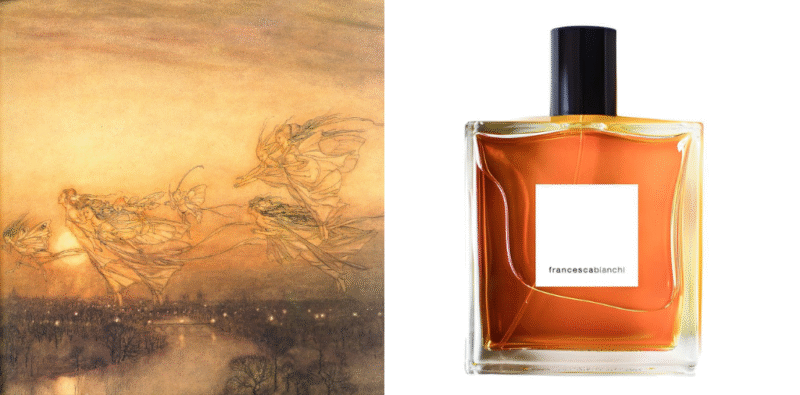
You are the reflection of the one I knew
before they became flesh.
— Jorge Luis Borges
By an unspoken rule of the genre, the most mesmerizing love stories always begin in darkness — perhaps to immediately repel those unworthy. Those who fear crossing through the dark are unworthy of light.
Fairies and elves — they’re not the same, yet mirror each other. In Celtic lore there are fairies, in Germanic and Norse myths there are elves, in Finnish tales forest spirits. Tolkien’s elves embodied nobility; Shakespeare’s, playful mischief; and for Francesca Bianchi — they became scent. Always, they serve the same purpose: to pull from within what hides inside and make the invisible visible. An elf is not a creature. It’s a state of being.
“They weep when we rejoice.
They laugh when we die.”
— English folklore about the “Good People”
But fairies are neither cruel nor kind. They don’t feel compassion as we do, yet they can comfort so deeply you forget who you were. In myths, they steal babies and leave changelings. They whisk humans to other worlds. But if you think about it — aren’t we humans doing the same? We replace our essence, reject our talents, abandon dreams — and become mere impostors of ourselves. In that light, fairies aren’t enemies of humans — they’re our potential, turned inside out and given form.
Fairies don’t lie — they distort. They don’t kill — they dissolve our outer shell, setting free hidden human passions.
“I saw in her gaze a meadow.
But when I stepped there, I fell into the sky.”
— Thomas de Quincey
We’re accustomed to sweetness being edible. But here — it’s not. It’s not chocolate — it’s patchouli: undeniably chocolate, but not flavor — an elixir. A mind-altering distortion. The honey here isn’t a treat — it’s primal, breathing, passionate energy. Everything feels familiar, yet warped, as if someone rebuilt a gourmet dessert from a dream. The cacophony and chaos at first dissolve into myriads of olfactory mosaics, each unique as a snowflake, each perfect.
A similar feeling washes over you when you stare at the night sky. At first—a void, distant sparks. Chaos. Then constellations emerge, galaxies come into view, and your mind races through light-years — into other worlds, toward other suns, or perhaps toward someone else entirely.
Francesca has undoubtedly walked that path — the path of embracing her own nature. She found new power and mastered the elvish. But humans don’t understand the language of fairies. So she began to create perfumes. Because the olfactory tongue is more universal than any verbal language.
Even here—the complexity remains. People fear her scents. Because it is that very darkness you must pass through to see the light and feel the fire’s embrace. Her elves speak not in words, but in scents. And if you hear them — it means your essence is ready to emerge.
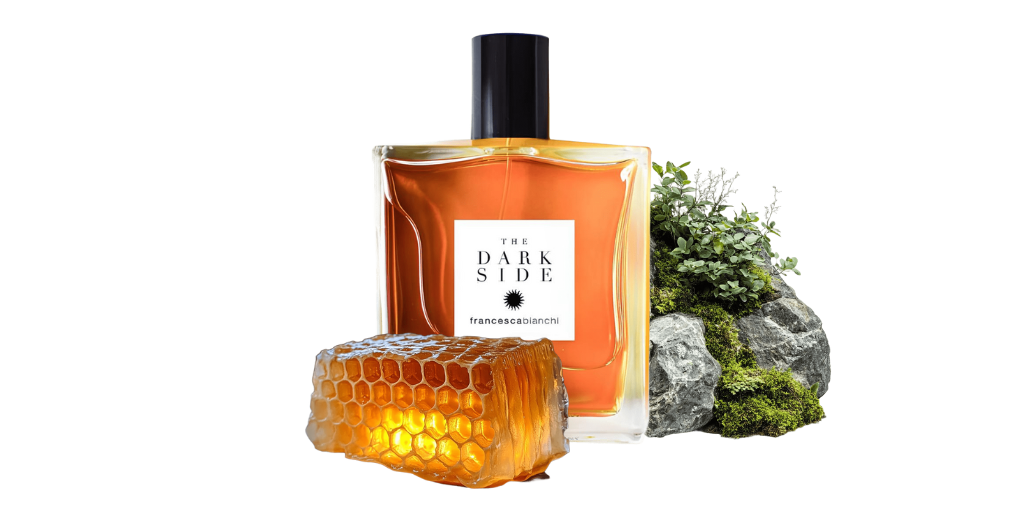
The Dark Side — the mature love between Alice and her Mad Hatter. He too is fairy-born but long ago crossed to the other side, so distant from common sense. Young Alice can’t understand him — even his simple words are warped, like the fragrance itself: each note familiar, yet entirely alien. Here honey smells of incense, sandalwood tastes like tea spice, violet is the color of the Hatter’s eyes, and iris is not powder — it’s sugar glaze. This is the Looking-Glass, The Dark Side.
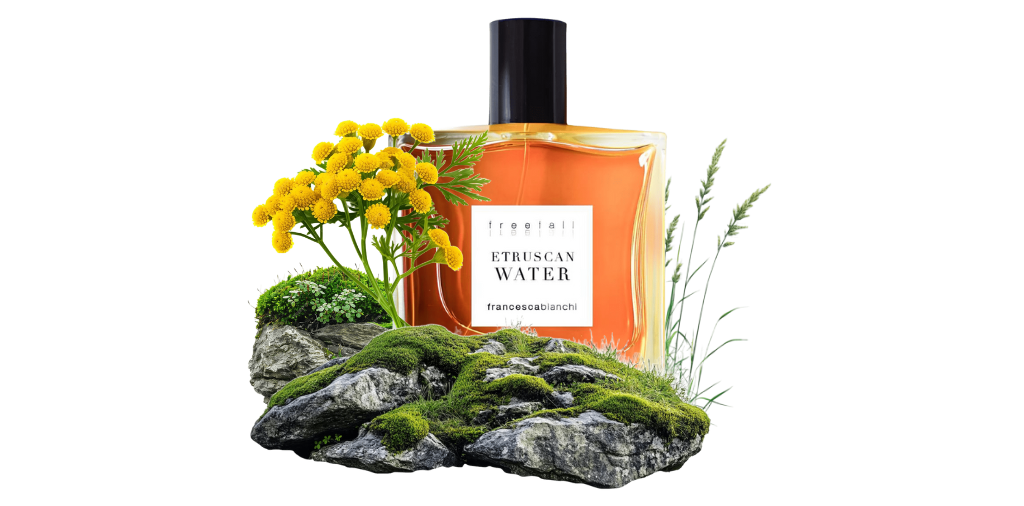
Etruscan Water — a forest from Guillermo del Toro’s darkest myth. A faun, ancient and fairy-born, hides true intent in distorted reality. Here water smells metallic, air thick with bitter herbs and smoke. This is a realm where essence defies words. Like in the film, the fragrance transforms, luring you into hidden corners — you easily lose your way and face primal fears. It’s a journey reminiscent of the heroine’s trials: to emerge anew.
True, intoxicating love always begins with trials. And anyone brave enough to face them will be touched by love — and shed their old self.